

 Solution
 Support Center
 About Us
 Contact
How to Reset iPhone Password If You Forgot it: Complete Guide
 Penny Warren Published on August 11, 2026Unlock iOS3-min reading
Your iPhone and iPad use multiple security features to protect your personal data and privacy, including the lock screen passcode, Apple ID password, and Screen Time passcode. Whether you want to update your password for security reasons or reset it after forgetting it, this guide will show you how to change passwords on your iPhone or iPad.

In this article:
Part 1. Different Types of Passwords on iPhone/iPad
Before changing a password on your iPhone or iPad, it is important to know which password you need to update. Apple devices use different passwords for different purposes, including:
- Lock screen passcode: Used to unlock your iPhone or iPad and protect your device data.
- Apple ID password: Used to access Apple services like iCloud, App Store, iMessage, and Find My.
- Screen Time passcode: Used to manage app limits, content restrictions, and parental controls.
- iPhone backup password: Used to encrypt local iPhone backups on a computer.
Each password has a different function, and the steps to change or reset them may vary. The following sections will show you how to change these passwords on your iPhone or iPad.
Part 2. How to Change Password on iPhone/iPad If You Know it
There are usually three most used passwords on your iPhone/iPad: Apple ID, screen lock, and screen time. If you remember your old passwords, updating passwords on Apple devices is easy. In the following paragraph, we will introduce how to change these passwords on your iPhone/iPad.
How to Change Lock Screen Password on iPhone/iPad
Apple and the news talk more about biometric security, Face ID, and Touch ID, you still need a passcode on your iPhone. Once you charged your handset and restart it, you must access the iPhone with a passcode. To make it handy, most people use memorable numbers. Therefore, you should change iPhone password regularly to protect yourself.
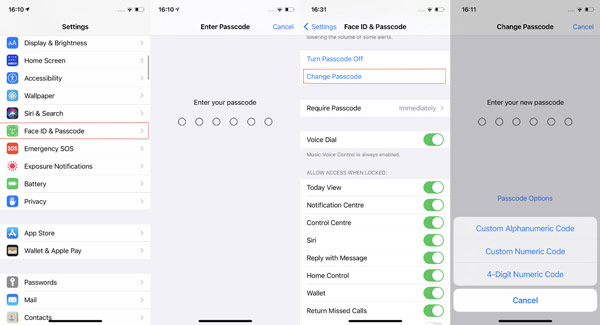
Run the Settings app from your home screen, and go to the Face ID & Passcode or Touch ID & Passcode tab depending on your iPhone model.
When prompted, enter the current passcode. Then scroll down and tap Change Passcode.
Again, enter the old passcode to confirm the ownership. Then you will reach the Change Passcode screen. Enter 6-digit new passcode and confirm it. To switch to 4-digit passcode or other types, press the Passcode Options button.
How to Change Apple ID Password on iPhone/iPad
Every Apple customer has an Apple ID and password. The credential is significant since it is the key to accessing Apple services, such as iCloud, iMessage, Apple Pay, and more. Moreover, you need it to set up a new iPhone. You can change your iPhone/iPad password in the Settings app.
Go to Settings. Tap your Profile at the top of the page.
Select Password & Security. Then, tap Change Password.
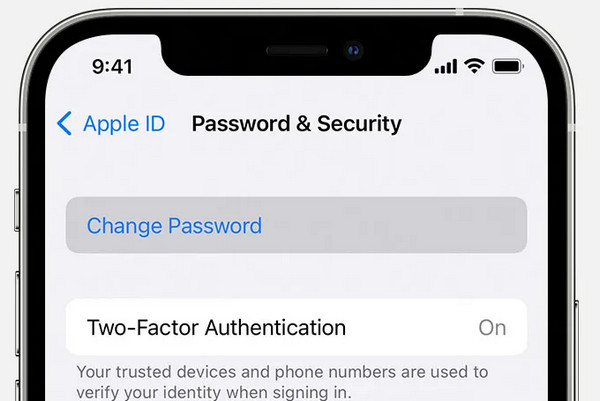
Enter your password, or use your Face ID/Touch ID. Then, enter your new Apple ID password and enter it again to confirm.
How to Change Screen Time Password on iPhone/iPad
Screen Time is used to set a limit on time spent on a certain app. It also requires a password, which is less frequently used than the previous two passwords. However, some users may need to change their Screen Time passcode, adjust restrictions, or turn off Downtime but don't know how to do it. The following is the detailed guidance.
Go to Settings > Screen Time. Then, tap Change Screen Time Passcode.
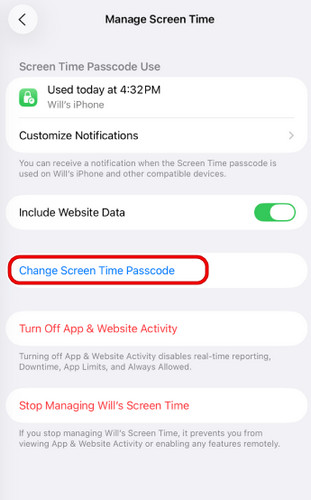
Enter your current screen time password. Then, you can update it to a new one.
Part 3. How to Change Password on iPhone/iPad When You Forgot it
Can you change your iPhone/iPad passcode when you forgot it? If you forget your iPhone or iPad passcode, you cannot change it directly from Settings because Apple requires the current passcode to verify your identity. In such case, you need to reset the forgotten passcode. Here are 3 practical ways you may need.
Note:
Resetting your iPhone/iPad passcode will erase all data on the device. Make sure you have a backup before proceeding if possible.
Method 1. Erase iPhone/iPad from the Lock Screen
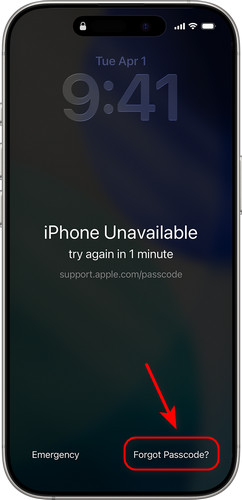
If your iPhone is running iOS 15.2 or later (or iPad is running iPadOS 15.2 or later) and connected to a network, you may see the Forgot Passcode? or Erase iPhone option after multiple failed passcode attempts.
Enter the wrong passcode several times until the security lockout screen appears.
Tap Forgot Passcode? or Erase iPhone/iPad at the bottom of the screen.
Follow the on-screen instructions and enter your Apple ID password to sign out of your account.
Tap Erase iPhone/iPad to perform a reset.
Method 2. Restore iPhone/iPad Using Recovery Mode
If you cannot change your passcode using the Forgot Passcode option, you can use a computer to restore your device through Recovery Mode.
First, you need to put your device into Recovery Mode.
For iPhone 8 and later:
Press and release the Volume Up button quickly. Press and release the Volume Down button quickly. Press and hold the Power button until you see Recovery Mode appear.
For iPhone 7 and iPhone 7 Plus:
Keep pressing the Volume Down button and Side button together until Recovery Mode appears on the screen.
For iPhone 6S or earlier:
Press the Home and Side buttons together and hold them until Recovery Mode appears on your phone.
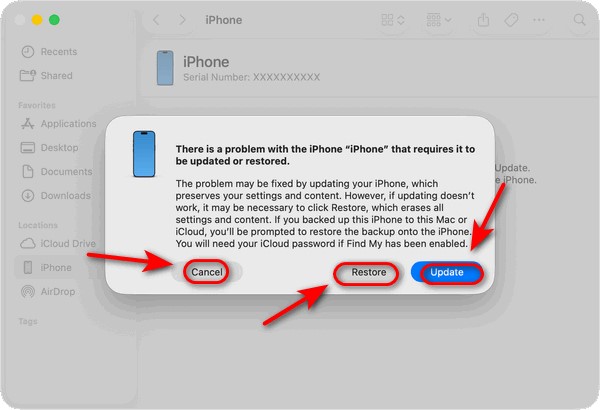
Connect your device to your computer using a USB cable and open iTunes/Finder.
Then you will see 3 options in the prompt window: Update, Restore, and Cancel. Choose Restore to reset your disabled iPhone or iPad.
Method 3. Use imyPass iPassGo to Remove Forgotten Passcode
If you want a simpler way to remove a forgotten passcode from iPhone or iPad, imyPass iPassGo can help reset your passcode within a few clicks. It supports removing 4-digit/6-digit passcodes, Face ID, and Touch ID when you cannot access your iPhone or iPad.

4,000,000+ Downloads
Reset forgotten screen passcode, Face ID, and Touch ID.
Unlock iPhone, iPad, and iPod Touch without passcode.
Bypass Screen Time password and remove MDM profiles.
Support the latest iOS 26/27 Beta and iPadOS 26/27 Beta.
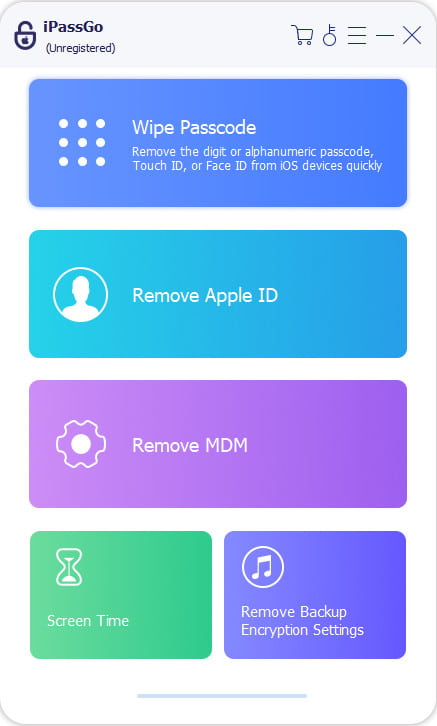
Launch the program on your computer. Select the Unlock iOS Screen mode from the interface. Connect your device to a computer using a USB cable, then click Start Now to continue.
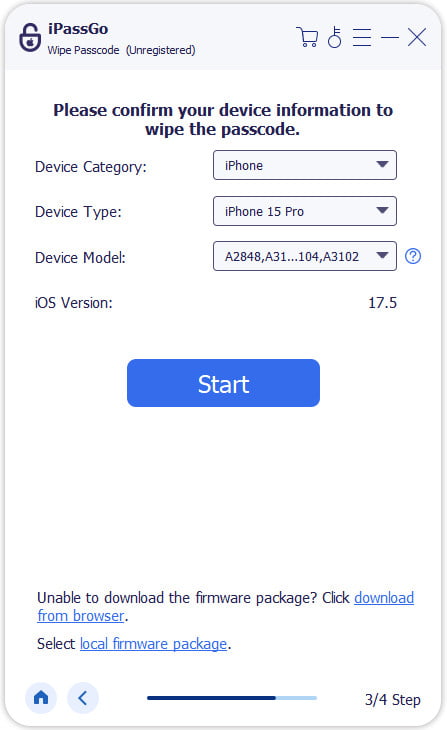
Confirm your device information and hit the Start Now button to download the firmware package. Wait for the download to complete and the firmware to be verified.
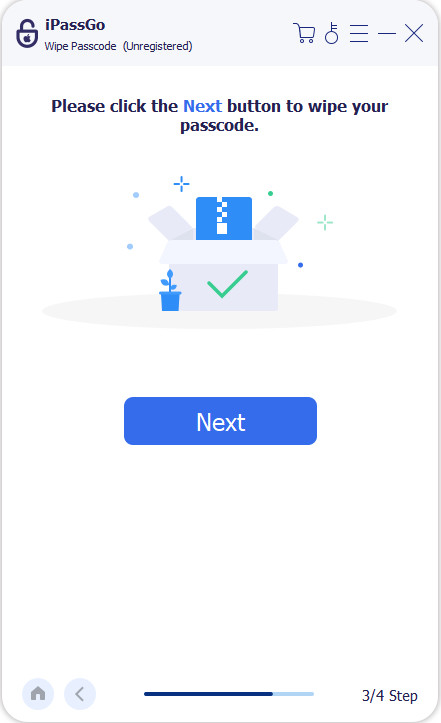
After verification, click the Start Removing button and confirm the reset again. The software will automatically reset the device, then you can set up your device.
Part 4. Tips to Manage iPhone/iPad Passwords
Managing your iPhone and iPad passwords properly can help protect your personal data and avoid forgetting them in the future. Here are some useful tips to keep your passwords secure.
1. Use a Strong and Unique Passcode
Avoid using simple passcodes like birthdays, repeated numbers, or other easy-to-guess combinations, like 888888 or 123456.
2. Update Your Passwords Regularly
Changing your device passcode and Apple ID password from time to time can reduce security risks. Avoid using the same password on multiple accounts.
3. Store Your Passwords Safely
If you use multiple passwords for your Apple devices and accounts, remembering all of them is challenging. A password manager like imyPass iPhone Password Manager can help you find, view, and manage saved passwords on your iPhone easily.
Conclusion
Following our guide, you should understand how to change your password on an iPhone/iPad. We have discussed the Apple ID password, as well as the lock screen passcode, and the screen time password. Plus, imyPass iPassGo is a good way to reset the password on your iOS device when you forgot it.
Penny focuses on GPS troubleshooting and Windows optimization. She formerly worked as a technical support engineer, helping clients solve location-based and system issues efficiently. Backed by IT support experience, she provides practical solutions that really work. In her free time, she likes hiking and geocaching, testing GPS tech in the real world.
Hot Solutions
-
Unlock iOS
-
iOS Tips
-
Unlock Android
-
Password Tips